


Key Takeaways
- Wash and condition your hair, then let it air-dry without leave-in or styling products before assessing your natural pattern.
- Compare the pattern across several areas of your head, as more than one hair type may be present.
- Consider porosity, density, strand texture, and your hair’s current needs—not just curl pattern—when building your routine.
Knowing your hair type can give you a helpful starting point for choosing products and styling techniques that work with your natural texture. But your curl pattern is only one piece of the puzzle. Factors like porosity, density, and strand texture can also affect how your hair looks, feels, and responds to different products.
First things first: To identify your hair type, wash and condition your hair, let it air-dry without leave-in products or heat, and observe the pattern that naturally forms. The 1A–4C hair typing system categorizes hair as Type 1 (straight), Type 2 (wavy), Type 3 (curly), or Type 4 (coily), with three subcategories within each type. Keep in mind that your hair may not fit neatly into a single category—and that’s completely normal.
Here’s what to know about finding where your strands fall on the hair type chart.
What Is the Hair Typing System?
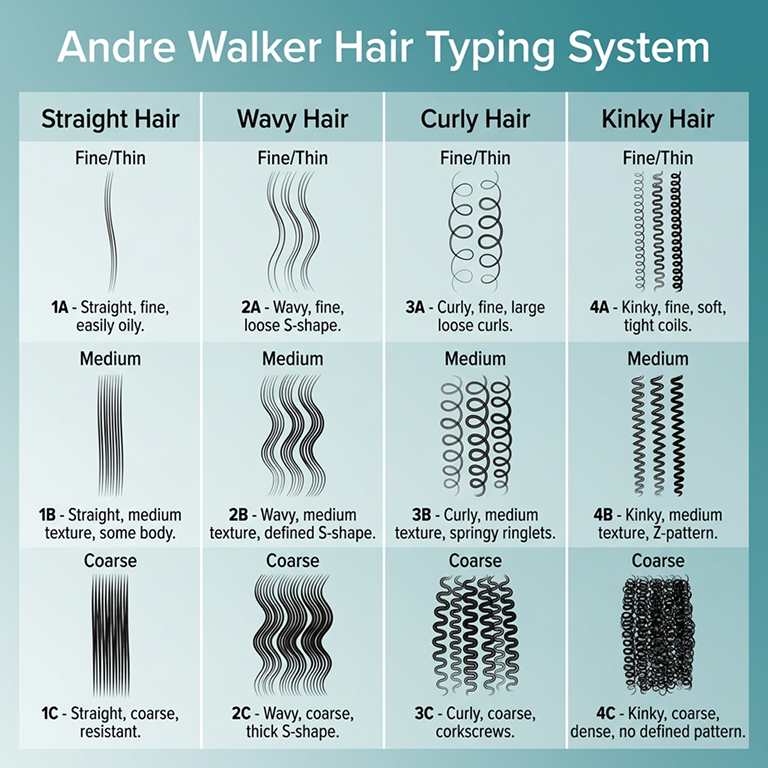
The Andre Walker Hair Typing System classifies hair based on its natural curl pattern. Type 1 is straight, Type 2 is wavy, Type 3 is curly, and Type 4 is coily, providing a simple framework for identifying and comparing visible hair patterns.
Each category is divided into A, B, and C subtypes. These letters describe the relative shape and tightness of the pattern within each type, with A generally representing a wider, looser pattern and C a narrower, tighter one.
Think of the chart as a helpful visual reference, rather than a complete guide to caring for your hair. The system describes the shape and tightness of your visible pattern, but your hair may have multiple patterns across your head and can respond differently to the same products or routine.
Myth-Busting Note: Hair Type Is Not Tied to Race or Ethnicity
Hair characteristics can vary widely within any population, so race or ethnicity alone cannot determine an individual’s curl pattern. A person may also have multiple patterns across different areas of the head.
How to Identify Your Hair Type in 3 Steps
A simple at-home check can reveal your hair’s natural texture. Starting with clean hair and allowing it to air-dry without leave-in or styling products or heat makes the visible pattern easier to compare with a hair type chart.
Step 1: Cleanse and Condition Your Hair
Wash and condition your hair thoroughly to remove buildup that could alter its natural pattern. Rinse completely.
Step 2: Let Your Hair Air-Dry Without Leave-In or Styling Products
After thoroughly rinsing the shampoo and conditioner, allow your hair to air-dry without applying leave-in conditioner, gel, mousse, curl cream, oil, or other stylers. Avoid hot tools, brushing, or vigorous towel-drying, since these can stretch or disrupt the visible pattern.
Step 3: Observe and Compare
Once your hair is fully dry, examine the shape that appears most often. Straight strands lie relatively flat, waves form an S shape, curls create ringlets or corkscrews, and coils form tight curves or zigzag patterns. Examine several areas, including the crown, hairline, sides, and underneath layers. If you notice more than one pattern, record the two most prominent types rather than forcing all your hair into a single category.
Hair-Type Borderlines Diagnostic: If you are deciding between 1C and 2A, 2C and 3A, 3C and 4A, or 4A and 4B/4C, compare where and how the pattern forms:
- Does the pattern begin at the root or mainly through the lengths?
- Is it an S-shaped wave, a complete spiral, a corkscrew, or a tight bend?
- Does the pattern remain visible when the hair is fully dry?
What Are the 1A–4C Hair Types?
Each hair type has recognizable pattern characteristics and care considerations. The categories below move from straight through coily hair, with subtypes that reflect differences in shape, tightness, and overall appearance.
Type 1: Straight Hair (1A, 1B, 1C)
Type 1 hair has little to no natural curl:
- Type 1A is very fine and lies flat
- Type 1B has medium strands with slightly more body
- Type 1C is thicker and may show a subtle bend
Because sebum can move easily along a straight hair shaft, Type 1 hair may appear oily more quickly, while styling needs can vary by strand thickness and density. Consider strand fineness and how quickly the roots appear oily when selecting a routine.
Type 2: Wavy Hair (2A, 2B, 2C)
Type 2 hair forms an S-shaped pattern:
- Type 2A has loose bends that often begin below the roots
- Type 2B has more defined elongated waves
- Type 2C has thicker waves that begin closer to the crown and may border on curls
Because wavy hair can be prone to frizz or limpness, account for density, porosity, and desired finish when choosing products. For lightweight wave definition, consider Matrix A Curl Can Dream Scrunch N’ Go Spray.
Type 3: Curly Hair (3A, 3B, 3C)
Type 3 hair forms springy curls:
- Type 3A has wide, loose ringlets
- Type 3B has smaller, bouncier spirals
- Type 3C has tight, densely packed corkscrew curls
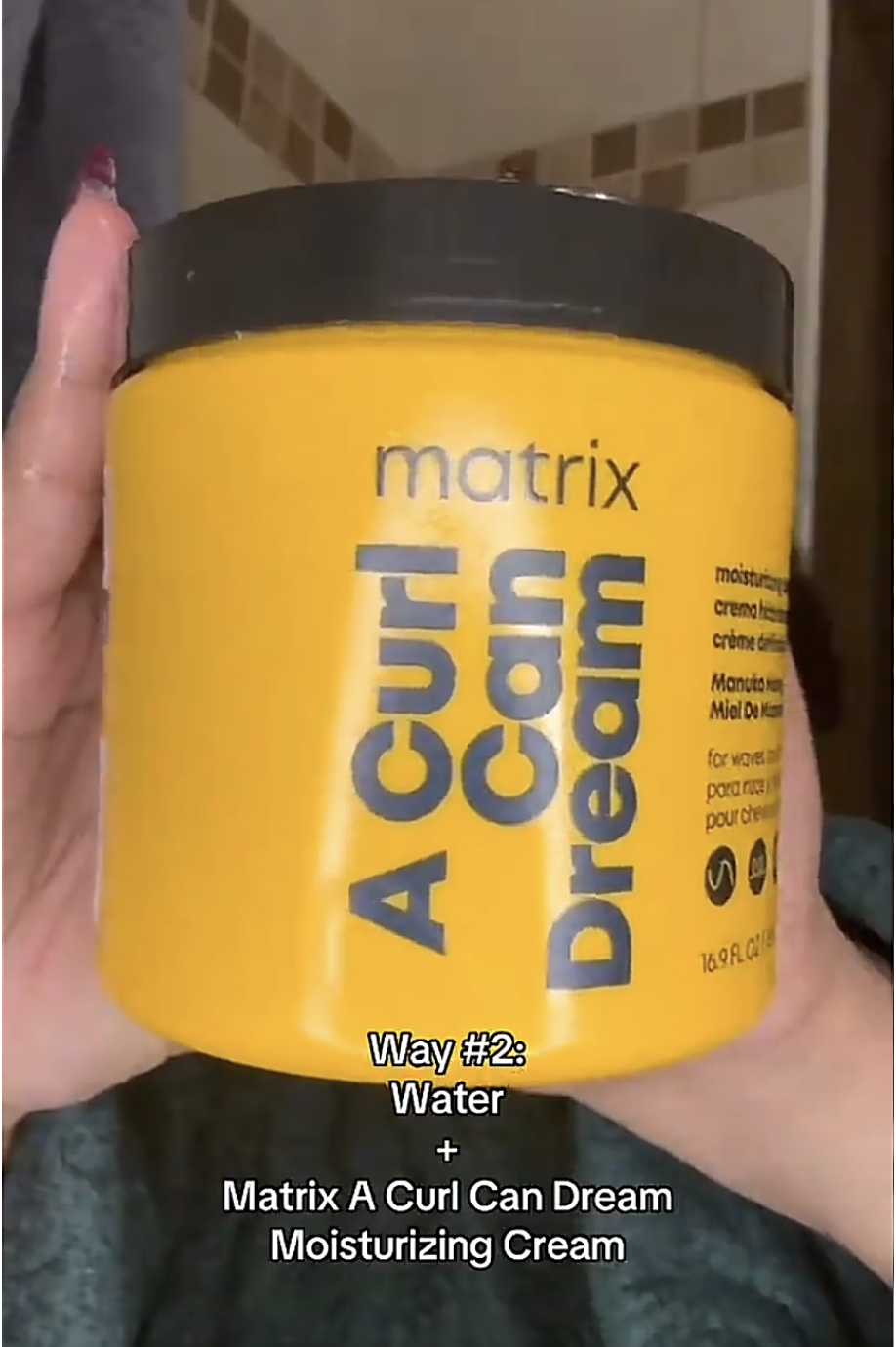
The curved pattern can make moisture distribution less even, so dryness and frizz may be common concerns. For lightweight curl definition, consider Matrix A Curl Can Dream Scrunch N’ Go Spray. For hair that needs a richer styling formula, consider Matrix A Curl Can Dream Moisturizing Cream.
Type 4: Coily Hair (4A, 4B, 4C)
Type 4 hair has tightly curved coils:
- Type 4A forms small, defined S-shaped coils
- Type 4B commonly forms tight bends or an angular, Z-shaped pattern
- Type 4C has a similarly tight pattern, though individual coils may be harder to distinguish without styling and may show more noticeable shrinkage
Because tightly curved hair can be susceptible to moisture loss and breakage, focus on moisture retention, gentle detangling, and reduced manipulation. For a richer conditioning step, consider Mizani Moisture Fusion Intense Moisturizing Mask. For a routine focused on adding moisture to the hair and scalp, consider Matrix A Curl Can Dream Hair & Scalp Oil.
How Do These Product Options Fit Into a Curl Routine?
| Product | Where It Can Fit in the Routine | Relevant Hair Types |
|---|---|---|
| Mizani Moisture Fusion Moisture Rich Shampoo | Use as the cleansing step to remove impurities when curls or coils need a moisture-focused wash. | 3A, 3B, 3C, 4A, 4B, 4C |
| Mizani True Textures Moisture Replenish Deep Conditioner | Use after shampooing as the rinse-out conditioning step for softness and easier detangling. | 3A, 3B, 3C, 4A, 4B, 4C |
| Mizani Moisture Fusion Intense Moisture Hair Mask | Use as a richer conditioning treatment when hair feels especially dry, in place of—or as directed alongside—regular conditioner. | 3A, 3B, 3C, 4A, 4B, 4C |
| Matrix A Curl Can Dream Scrunch N’ Go Defining Spray | Apply after washing and conditioning for lightweight wave or curl definition, not before assessing the natural pattern. | 2A, 2B, 2C, 3A, 3B, 3C |
| Matrix A Curl Can Dream Hair & Scalp Oil | Use as a finishing step for moisture and shine, adjusting the amount to hair density and how readily hair becomes weighed down. | 3A, 3B, 3C, 4A, 4B, 4C |
| Matrix A Curl Can Dream Moisturizing Cream | Apply after cleansing and conditioning when curls or coils need a richer styling formula for moisture and definition. | 3A, 3B, 3C, 4A, 4B, 4C |
How Do Porosity, Density, and Strand Texture Affect Your Hair Type?
While your curl pattern is the fastest way to categorize hair type, it’s only part of the story. Porosity, density, and strand texture are just as important—they shape how your hair feels, holds moisture, and responds to different products and techniques. These characteristics help explain why two people with similar-looking curls may have completely different hair routines or results.
What Is Hair Porosity?
Hair porosity describes how easily your hair absorbs and retains moisture:
- Low-porosity hair means the cuticle layer is tightly packed, so products and water tend to sit on the surface rather than soak in—making it prone to buildup, but slower to lose moisture.
- High-porosity hair, often due to genetics or damage, soaks up moisture quickly but also loses it just as fast, which can lead to dryness and frizz.
- Medium-porosity hair usually maintains the healthiest moisture balance and tends to be easiest to style and hydrate.
Knowing your porosity allows you to choose products and techniques that work for your hair’s unique needs—think lightweight milks or mists for low-porosity, richer creams for high-porosity.
What Are Hair Density and Strand Texture?
Density is about how many hairs grow per square inch of your scalp—it’s usually described as low, medium, or high. High-density hair often looks fuller and can handle heavier products without looking flat, while low-density hair benefits from lighter products and volumizing techniques for a fuller effect.
Strand texture refers to the actual thickness of each individual hair:
- Fine strands are delicate and can easily get weighed down by heavy products.
- Coarse strands are thicker and often need more moisture and richer styling creams.
- Medium strands fall in between and may handle a wider range of products.
Understanding both density and strand thickness helps you tailor not just the amount of product you use, but also how you layer and style your hair for best results.
Your Hair Type Questions, Answered
Questions often come up after identifying a hair type, especially when patterns overlap or hair characteristics change. These answers clarify how curl pattern relates to texture, porosity, product choices, and changes over time.
Can you have multiple hair types, and do you need different products for each?
Yes. Different areas of the head may display different patterns. Rather than choosing products based only on the predominant curl type, consider concerns shared across sections, such as dryness, frizz, or lack of definition. You can also adjust product amounts or application methods in individual areas, rather than using a completely different routine for each pattern.
How is hair type different from hair texture
Hair type refers to your hair's curl pattern (straight, wavy, curly, coily). Hair texture refers to the thickness or circumference of the individual strands (fine, medium, coarse). You can have coily hair that is fine-textured, or straight hair that is coarse-textured.
Does hair type change over time?
Your visible pattern can appear different over time. Temporary changes may result from styling, humidity, product buildup, or heat and chemical damage. Longer-term changes may occur with aging or hormonal shifts associated with puberty, pregnancy, or menopause; medications may also affect how the hair looks or behaves.
To tell the difference, observe clean, air-dried new growth rather than only the processed lengths. If a change is sustained, reassess your pattern and adjust your routine as needed. Consider seeking input from a dermatologist or another qualified professional if a sudden texture change occurs alongside increased shedding, scalp discomfort, irritation, flaking, or other scalp symptoms.
What is the difference between 4B and 4C hair?
Type 4B hair commonly forms tight bends or an angular, Z-shaped pattern. Type 4C hair generally has a similarly tight pattern, but the individual coils may be harder to distinguish without styling and may display more noticeable shrinkage. Different patterns can also appear together on the same head.
How do I know if I have high porosity hair?
High-porosity hair may take in water quickly and may also lose moisture readily, which can contribute to dryness or frizz concerns. Because at-home observations do not provide a definitive porosity diagnosis, consider how the hair responds to water and conditioning products over time rather than relying on a single float test.
Product selections are made using editorial research and brand knowledge; personal use or testimonials are noted where applicable


